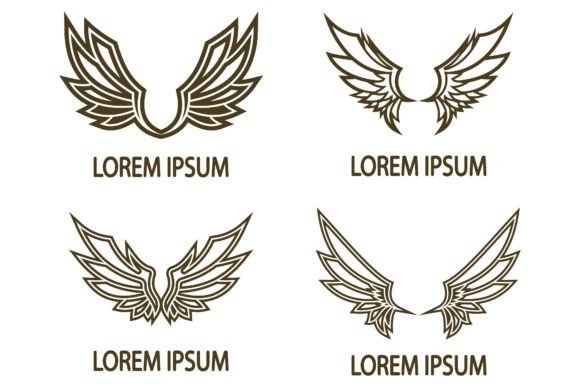
Strategic Implementation of the Wings Logo for Brand Authority and Market Positioning
In the saturated landscape of modern branding, visual symbols must do more than simply look attractive; they must communicate complex organizational values instantly. The Wings Logo stands as one of the most enduring and versatile assets in a designer's arsenal, transcending industries from aviation logistics to spiritual wellness platforms. However, its ubiquity presents a unique challenge: how does a business leverage such a common motif to create a distinct, memorable identity without falling into the trap of cliché? The answer lies not in the symbol itself, but in the strategic intent behind its application. When approached with rigor and clarity, a winged emblem can elevate a brand narrative, signaling speed, freedom, protection, or ascension depending on the specific execution and context.
At its core, the concept of wings in branding taps into universal human archetypes. Historically associated with deities, messengers, and predators, wings convey a sense of power and capability that few other shapes can match. For an entrepreneur or marketing director, understanding these underlying associations is critical before commissioning or selecting a design. A Wings Logo is not merely a decorative element; it is a semantic shortcut. It tells the customer what to expect before they read a single word of copy. If your value proposition revolves around rapid delivery, a stylized, forward-sweeping wing suggests efficiency and momentum. Conversely, if your brand promise is centered on security and oversight, a heraldic, shield-encased wing design communicates stability and guardianship. The failure to align the visual style of the wings with the actual business operation is where many brands lose credibility.
Aligning Visual Semantics with Business Goals
The utility of a Wings Logo extends across diverse sectors, but its effectiveness is entirely dependent on contextual alignment. Consider the technology sector, where "cloud" computing and data mobility are paramount. Here, a minimal, geometric interpretation of wings can represent the seamless flow of information and the lifting of constraints through software innovation. In contrast, the luxury goods market often utilizes gold-foiled, intricate feather details to evoke notions of exclusivity, heritage, and high craftsmanship. Using a flat, generic vector icon in a high-end jewelry context would dilute the perceived value of the product, just as an overly ornate, vintage crest might confuse customers of a fintech startup aiming for disruption and simplicity.
Strategic planning requires asking difficult questions about what the logo needs to achieve. Are you trying to signal speed, like a courier service? Do you need to project protection, like an insurance firm? Or is the goal to inspire aspiration, like a fitness coach or educational institution? The specific morphology of the wing matters immensely. Sharp, angular lines suggest precision, aggression, and high performance—ideal for sports brands or competitive gaming teams. Soft, curved, and flowing lines suggest grace, care, and organic growth, which resonates better with healthcare providers, non-profits, or wellness retreats. Making the wrong choice here creates cognitive dissonance for the consumer, forcing them to work harder to understand your brand, which often leads to disengagement.
Navigating the Risks of Generic Design
One of the most significant risks associated with adopting a Wings Logo is the potential for anonymity. Because the motif is so popular, there is a high probability that your final design will bear a striking resemblance to competitors if not executed with extreme care. A generic silhouette of an eagle or a standard pair of spread wings can make a company feel like a commodity rather than a unique entity. This is particularly dangerous in crowded markets such as shipping, automotive repair, or travel agencies, where differentiation is the primary driver of customer acquisition.
To mitigate this, decision-makers must move beyond stock templates and pre-made vectors. While a "collection" of ready-made assets might seem cost-effective in the short term, it rarely supports long-term brand equity. A truly effective logo requires custom illustration that considers the specific nuances of the brand name, the industry landscape, and the target audience. This involves thoughtful manipulation of negative space, unique integration of typography (logotypes), and perhaps the fusion of the wing element with other distinct symbols relevant to the business. For instance, merging a wing with a quill for a publishing house, or integrating wing dynamics into the letterforms of the company name, creates a proprietary asset that cannot be easily replicated.
- Avoid Literalism: Instead of drawing a realistic bird, consider abstract representations that suggest flight through motion lines or geometric fragmentation.
- Contextual Testing: Evaluate how the logo performs in monochrome, at small scales (such as favicons or app icons), and in reverse (light on dark). Complex feather details often vanish when scaled down, rendering the logo ineffective for digital touchpoints.
- Cultural Sensitivity: Be aware that certain bird species or wing styles carry specific cultural or military connotations that may not align with a global or inclusive brand strategy.
- Future-Proofing: Trends in design shift rapidly. A hyper-realistic 3D metallic wing might look trendy today but dated in five years. Aim for timeless simplicity over temporary stylistic flourishes.
Operationalizing the Brand Identity
Once a strategic direction is chosen and the Wings Logo is finalized, the focus must shift to consistent application. A logo is only as strong as the system built around it. This means developing comprehensive brand guidelines that dictate exactly how the symbol interacts with other elements. How much clear space is required around the wings? What color palettes complement the emblem without overpowering it? For a brand aiming for a "premium" feel, the use of metallic gradients, deep blacks, and stark whites can enhance the perception of quality. For a brand focused on "energy" and "youth," vibrant, multicolor gradients or neon accents might be more appropriate.
Furthermore, the logo should act as an anchor for all communication channels. In digital environments, the animated potential of a winged logo offers unique opportunities for engagement. Subtle motion graphics—where the wings gently hover or unfold upon page load—can reinforce the concepts of dynamism and innovation without being distracting. In physical applications, such as packaging, uniforms, or vehicle fleets, the texture and material finish become part of the brand experience. A debossed wing logo on high-quality paper stock conveys a tactile sense of authority that a flat print cannot achieve.
Long-Term Value and Adaptability
The ultimate measure of a successful Wings Logo is its longevity and adaptability. Businesses evolve, markets shift, and product lines expand. A rigid, overly complex design may hinder this evolution, requiring a costly rebrand later down the line. Strategic foresight involves designing a logo that can stretch. Can the wing element be separated from the text to serve as a standalone icon for social media avatars? Can the color scheme be adapted for seasonal campaigns without losing recognition? The most powerful brands treat their logos as living assets that grow with the company.
It is also vital to consider the psychological impact on internal stakeholders. A well-designed logo fosters pride among employees and partners. When a team sees a symbol that accurately reflects their mission—whether it's the "freedom" of a travel agency or the "strength" of a security firm—it reinforces corporate culture and alignment. This internal buy-in is often an overlooked aspect of branding strategy, yet it is crucial for consistent customer experiences. If the staff believes in the symbol, they will embody the values it represents in their daily interactions.
In conclusion, the decision to utilize a Wings Logo should never be taken lightly or treated as a mere aesthetic preference. It is a strategic tool that, when wielded with intention, can clarify your market position, accelerate brand recall, and deepen emotional connections with your audience. By prioritizing custom design over generic templates, aligning visual semantics with core business goals, and planning for long-term adaptability, organizations can transform a common motif into a distinctive mark of excellence. The path to a successful brand identity is paved with thoughtful analysis and disciplined execution, ensuring that every element, from the curve of a feather to the weight of a line, serves a deliberate purpose in achieving your broader objectives.